

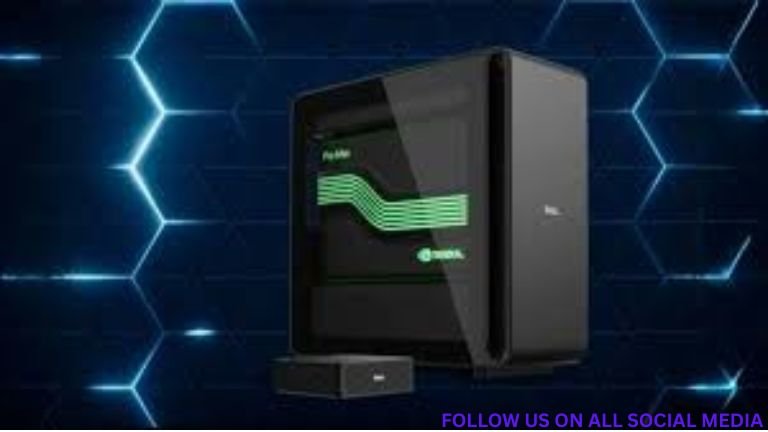
Dell Unveils Pro Max Desktop with Nvidia GB300 Superchip — A Game Changer for AI Developers
The future of artificial intelligence is no longer confined to massive data centers. In a move that could redefine how developers build and run advanced AI systems, Dell has introduced its powerful new Pro Max desktop, equipped with Nvidia’s latest GB10 and GB300 superchips.
This is not just another desktop launch. It marks a significant shift in how AI computing power is delivered. For the first time, developers and enterprises can access extremely high performance AI capabilities directly from a desktop machine.
Dell has also made history by becoming the first original equipment manufacturer to bring a GB300 based solution to the market. This gives the company a strong lead in the rapidly growing AI hardware space.
Bringing Supercomputing Power to the Desktop
One of the most striking features of the Dell Pro Max desktop is the level of performance it offers. Powered by the Nvidia GB300 Grace Blackwell Ultra Desktop Superchip, this system delivers up to 20 petaFLOPS of computing power.
To put that into perspective, this level of performance was once only available in large scale supercomputers or cloud based infrastructure. Now, it is being brought directly to developers’ desks.
The system also includes up to 748GB of memory, which is a massive upgrade compared to traditional desktops. This allows developers to work with large AI models, complex datasets, and advanced simulations without relying entirely on external servers.
For developers working on cutting edge AI projects, this could significantly reduce latency, improve efficiency, and enhance overall productivity.
Why This Launch Matters Right Now
The timing of this launch is crucial. Artificial intelligence is rapidly evolving, and the industry is moving towards more advanced systems known as autonomous agents.
These are not simple AI tools that perform one task at a time. Instead, autonomous agents can handle complex, multi step processes, make decisions, and even learn from their own actions.
Until now, running such advanced AI systems required access to expensive cloud infrastructure or dedicated data centers. Dell’s new Pro Max desktop changes that by making high performance AI computing more accessible.
This means smaller teams, startups, and individual developers can now experiment with powerful AI systems without needing massive infrastructure.
Designed for the Next Generation of AI
Dell’s Pro Max desktop is not just about raw performance. It is specifically designed to support the next generation of AI technologies.
The system supports Nvidia NemoClaw and Nvidia OpenShell, which are part of a broader ecosystem aimed at simplifying and securing AI development.
NemoClaw is an open source stack that allows developers to run advanced AI assistants more easily and safely. With simple commands, developers can deploy AI systems that are capable of handling complex workflows.
OpenShell, on the other hand, provides a secure environment for running autonomous agents. It acts as a runtime platform where AI systems can operate safely without risking sensitive data.
Together, these tools create a powerful environment for building, testing, and deploying advanced AI applications.
The Rise of Autonomous AI Agents
The concept of autonomous agents is becoming one of the most talked about trends in the AI industry.
Earlier in 2026, the release of OpenClaw demonstrated the potential of these systems. Unlike traditional AI models, autonomous agents can perform tasks over extended periods, break down problems into smaller steps, and even create specialised sub agents to handle specific tasks.
For example, an autonomous agent could manage an entire workflow such as coding, testing, and deployment without constant human intervention.
This represents a major shift in how software is developed and how businesses operate.
Dell’s Pro Max desktop is designed to support exactly this kind of innovation. By providing powerful local computing and secure environments, it enables developers to build and run these advanced systems more efficiently.
Privacy and Security Take Center Stage
One of the biggest concerns in AI development today is data privacy and security. Many organisations are hesitant to rely entirely on cloud based solutions, especially when dealing with sensitive or confidential data.
Dell and Nvidia are addressing this concern by focusing on local computing and secure environments.
With Nvidia OpenShell, AI agents can run in isolated environments where they start with zero permissions. This ensures that sensitive data remains protected and that AI systems operate within controlled boundaries.
Additionally, inference processes remain private by default, which is a major advantage for enterprises that need to maintain strict data security standards.
This approach makes the Dell Pro Max desktop particularly appealing for industries such as finance, healthcare, and government, where data privacy is critical.
A Step Towards Decentralised AI Computing
The introduction of powerful AI desktops like the Dell Pro Max signals a broader shift in the industry.
Instead of relying solely on centralised cloud infrastructure, companies are now exploring decentralised approaches where computing power is distributed across multiple devices.
This not only improves performance but also reduces dependency on external systems and enhances data control.
For developers, this means more flexibility and faster iteration cycles. They can build, test, and deploy AI models locally before scaling them to larger systems if needed.
Early Reactions and Industry Impact
The announcement has already generated strong interest among developers and tech enthusiasts.
Many see this as a turning point in AI development, where high performance computing becomes more accessible and practical for everyday use.
If Dell’s Pro Max desktop delivers on its promises, it could reshape how AI projects are developed and deployed across industries.